Ages Without Apps
Subscribe to be there when it goes live.
Full video · October 17, 2026 · Coming soon
How Did Medieval People Survive Winter Without Heating?
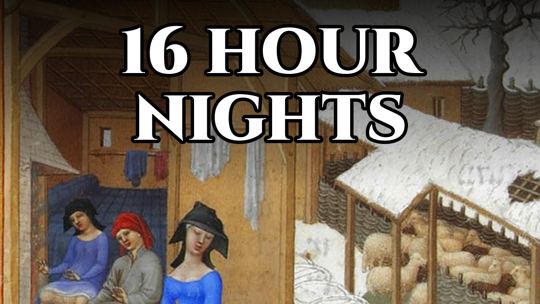
How did medieval people survive winter without heating, without glass in the windows, and with nights sixteen hours long? Not with one trick, but with a whole system: a fire in the middle of the floor, wool and fur by law and rank, a pig killed in "blood month", a shared straw bed, a bell that told you to cover your fire, and twelve days of feasting in the darkest weeks.
Key facts about how did medieval people survive winter
- A fire in the middle of the floor, wool and fur by law and rank, a pig killed in "blood month", a shared straw bed, a bell that told you to cover your fire, and twelve days of feasting in the darkest weeks.
What the video covers
- Winter without heating
- The fire in the middle of the room
- Wool, linen & fur
- Blood month, salt & smoke
- The straw bed
- Did they ever wash?
- Rushlights & the bell
- The twelve days
- When the weather turned
A note on the evidence
- We follow one medieval winter through the people who lived it: a country parson's memories of houses without chimneys, a Paris household manual, a monk explaining November's old name, a poet describing poor women in winter, and the rains of 1315.
Sources for how did medieval people survive winter
- William Harrison, Description of England (1577/1587), Bk II ch. 12
- Statute concerning diet and apparel, 37 Edw. III (1363), Statutes of the Realm I
- Le Ménagier de Paris (c. 1393), trans. E. Power, The Goodman of Paris (1928)
- Bede, De temporum ratione 15 (725)
- Thomas Tusser, Five Hundred Points of Good Husbandry (1573)
- William Langland, Piers Plowman C.IX; Chaucer, Reeve's Tale and Franklin's Tale; Sir Gawain and the Green Knight
- Étienne Boileau, Livre des métiers, "Des estuveurs"
- London curfew ordinance 1285 (Anglo Norman Dictionary, s.v. coverfeu)
- Thirteen Custumals of the Sussex Manors of the Bishop of Chichester, ed. W. D. Peckham (1925)
- Robert Herrick, Hesperides (1648)
- E. Gee, "Heating in the Late Middle Ages", Trans. Ancient Monuments Society 31 (1987)
- English Heritage / Historic England, Hound Tor deserted medieval village
- C. M. Woolgar, "Take this penance now…: seafood and late medieval diet", in England's Sea Fisheries (2000), pp. 36 to 37
- A. Sapoznik, "Bees in the medieval economy", Economic History Review (2019)
- R. Fouquet & P. Pearson, "Seven Centuries of Energy Services", Energy Journal (2006)
- A. R. Ekirch, "Sleep We Have Lost", AHR (2001), and the 2023 reconsideration
- A. Classen, "The 'Dirty Middle Ages'" (2017)
- W. C. Jordan, The Great Famine (1996)
- R. Neukom et al., Nature 571 (2019)
Questions people ask
What are the key facts: how did medieval people survive winter?
A fire in the middle of the floor, wool and fur by law and rank, a pig killed in "blood month", a shared straw bed, a bell that told you to cover your fire, and twelve days of feasting in the darkest weeks.
Is any of this disputed or uncertain?
We follow one medieval winter through the people who lived it: a country parson's memories of houses without chimneys, a Paris household manual, a monk explaining November's old name, a poet describing poor women in winter, and the rains of 1315.
Where can I check the sources?
This page lists 19 sources, including: William Harrison, Description of England; Statute concerning diet and apparel, 37 Edw. III; Le Ménagier de Paris.
Enjoyed this story?
Subscribe for the next one.