Ages Without Apps
Short · October 7, 2026
Shaduf: How Ancient Egypt Lifted Water Without Electricity
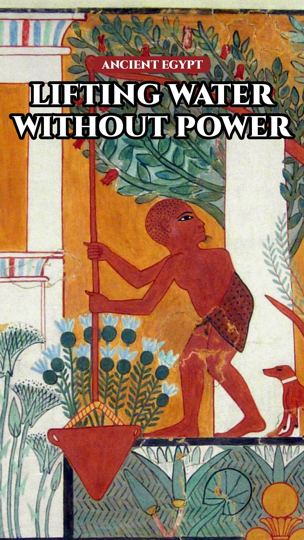
A painting in an Egyptian tomb more than 3,000 years old shows a man lifting water with a shaduf, and the same simple machine was still lifting Nile water when John Singer Sargent painted it in 1890 to 91. A shaduf is a long pole balanced like a seesaw on a post: a bucket hangs from the long end and a heavy counterweight sits on the short end.
Key facts about shaduf
- You pull the bucket down into the water, let go, and the weight swings it back up so you can empty it into a field channel.
- Shadufs were sometimes set one above another to lift water higher.
A note on the evidence
- The water screw is a spiral inside a tilted tube. Turn it, and water climbs the spiral and spills out the top. It is named after the Greek scientist Archimedes (c. 287 to 212 BC), and Diodorus, writing in the 1st century BC, credits him with it and says Egyptian farmers used it to irrigate the Nile Delta. But it may be older: historians Stephanie Dalley and John Peter Oleson argue that an inscription of the Assyrian king Sennacherib, around 700 BC, may describe water screws at his capital, Nineveh. So "credited to Archimedes" is safer than "invented by Archimedes".
Sources for shaduf
- The Metropolitan Museum of Art, "Garden Scene, Tomb of Ipuy", facsimile by Norman de Garis Davies of a painting from the Tomb of Ipuy, c. 1290 to 1224 BC (30.4.115, Open Access)
- Encyclopaedia Britannica, "Shaduf"
- Encyclopaedia Britannica, "Archimedes screw"
- Stephanie Dalley and John Peter Oleson, "Sennacherib, Archimedes, and the Water Screw", Technology and Culture 44 (2003): 1 to 26, doi:10.1353/tech.2003.0011
- Diodorus Siculus, Library of History I.34.2 (the Delta irrigated with the screw "invented by Archimedes of Syracuse"), Loeb translation on LacusCurtius
- Vitruvius, On Architecture X.6 (how to build the water screw), on LacusCurtius
Images: the opening painting is the Met's facsimile (CC0) of a garden scene in the Tomb of Ipuy, c. 1290 to 1224 BC, photographed in its display case. "Egyptians Raising Water from the Nile" is a study by John Singer Sargent, 1890 to 91 (Met, CC0). The photo of shadufs in Upper Egypt is by the Zangaki brothers, late 1800s (Library of Congress; the catalogue gives 1860, but the studio worked c. 1870s to 1890s). The water screw woodcut illustrates Vitruvius X.6 (published 1914). The portrait of Archimedes is imagined, painted by Domenico Fetti about 1620. The shaduf and screw diagrams are our own simplified drawings.
Questions people ask
What are the key facts about shaduf?
You pull the bucket down into the water, let go, and the weight swings it back up so you can empty it into a field channel. Shadufs were sometimes set one above another to lift water higher.
Is any of this disputed or uncertain?
The water screw is a spiral inside a tilted tube. Turn it, and water climbs the spiral and spills out the top. It is named after the Greek scientist Archimedes (c. 287 to 212 BC), and Diodorus, writing in the 1st century BC, credits him with it and says Egyptian farmers used it to irrigate the Nile Delta. But it may be older: historians Stephanie Dalley and John Peter Oleson argue that an inscription of the Assyrian king Sennacherib, around 700 BC, may describe water screws at his capital, Nineveh. So "credited to Archimedes" is safer than "invented by Archimedes".
Where can I check the sources?
This page lists 6 sources, including: The Metropolitan Museum of Art, "Garden Scene, Tomb of Ipuy", facsimile by Norman de Garis Davies of a painting from the Tomb of Ipuy, c. 1290 to 1224 BC; Encyclopaedia Britannica, "Shaduf"; Encyclopaedia Britannica, "Archimedes screw".
Where can I watch the video?
The Short is on the Ages Without Apps YouTube channel, and you can watch it on this page.
Enjoyed this story?
Subscribe for the next one.